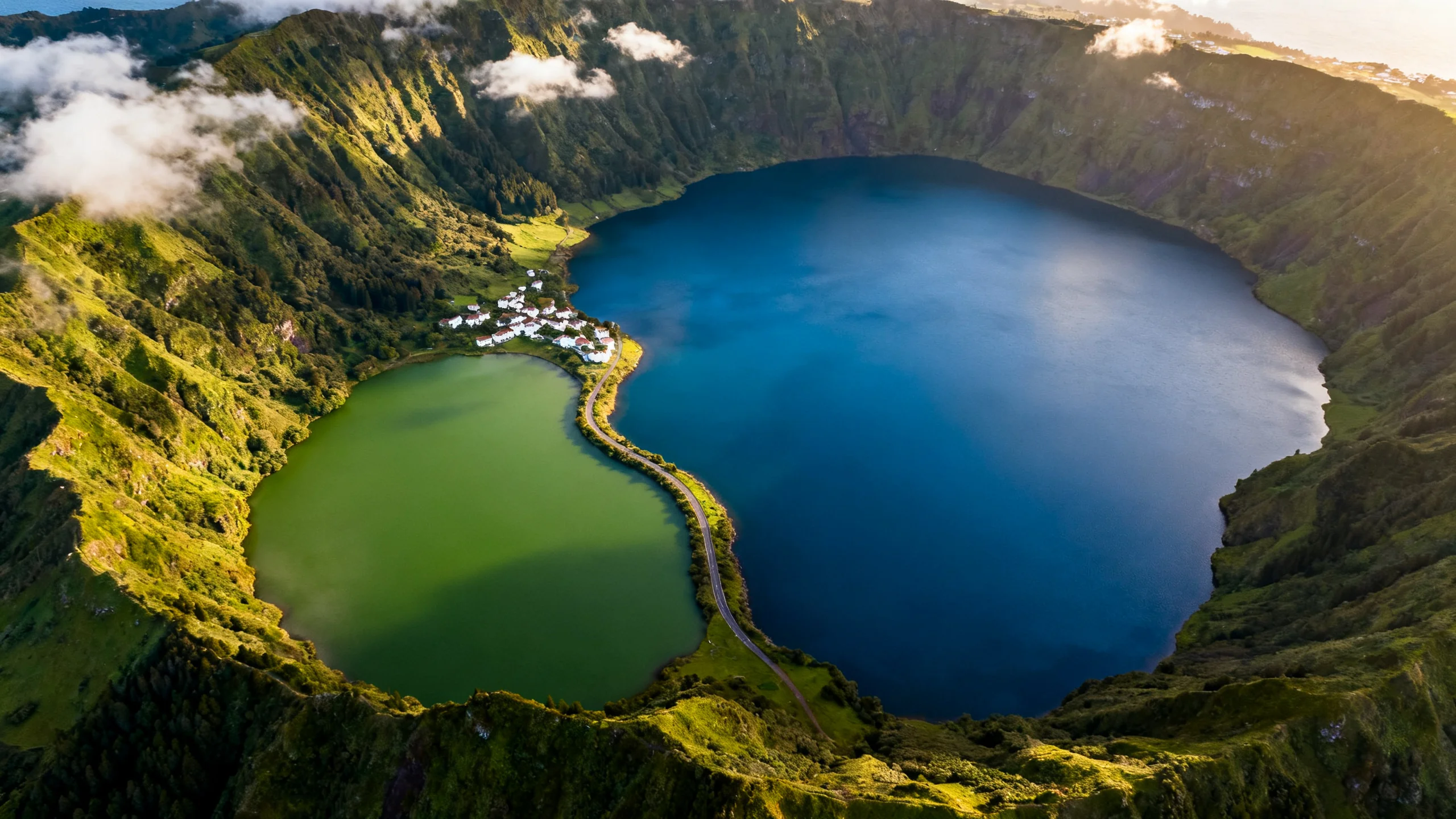
The Azores has 88 named lakes, almost all of them inside volcanic calderas. The story of how they formed, the most beautiful ones, and what lives in them.
The Azores has 88 named lakes. Almost all of them sit inside volcanic calderas, and they exist because the archipelago is what happens when the floor of the Atlantic spits up basalt for a few million years and then collapses on itself. The most famous lakes (Sete Cidades, Lagoa do Fogo, Lagoa das Furnas) draw the photographs. The lesser-known ones have their own stories.
This guide covers how the lakes formed, the eight you should know about, the deepest and the smallest, and the strange biology that develops when a piece of water sits inside a 280-metre-deep crater for ten thousand years.
How the lakes formed
Three geological processes made the Azorean lakes.
Caldera collapse. When a magma chamber under a stratovolcano empties out (either through eruption or quiet subsidence), the cone above collapses inward, leaving a circular depression of 1 to 5 kilometres in diameter. Rainwater fills the depression. Lagoa do Fogo (São Miguel), Lagoa do Caldeirão (Corvo), Caldeira do Faial are all caldera lakes.
Crater lakes. Smaller and shallower, inside a single eruptive crater (not a collapsed caldera). The two lakes of Sete Cidades are crater lakes inside the larger Sete Cidades caldera, formed by later smaller eruptions punching through the caldera floor.
Maar lakes. A maar is a low-relief crater formed when magma meets groundwater and the resulting steam explosion blows a hole in the landscape. Several smaller Azorean lakes (Lagoa do Congro, Lagoa do Canário) are maars.
All three types share two characteristics: they are circular or elliptical (the geometry of explosive volcanism), and they are hydrologically isolated from the sea. The water is fresh.
The eight lakes that matter
1. Lagoa do Fogo (São Miguel)
The largest lake on São Miguel and the most pristine. Inside a 4-kilometre caldera at 575 metres altitude, with a deep blue colour and a white-sand beach on its south shore. A protected nature reserve. The only crater lake on São Miguel where you can swim from a real beach. See the Lagoa do Fogo hike for the descent trail.
2. Sete Cidades twin lakes (São Miguel)
The classic Azores postcard. Two adjoining lakes (the green one and the blue one) inside a 12-kilometre caldera, joined by a narrow strip of land that carries the village road. The colour difference is an optical artefact (water depth, sediment, angle of sun) rather than chemical, but the lakes do have slightly different mineral profiles. See the Sete Cidades jeep tour for the guided rim circuit.
3. Lagoa das Furnas (São Miguel)
The lake at the floor of the Furnas valley, 3 kilometres long. Fed by the same geothermal system that powers the cozido cooking pots on its north shore. Slightly mineral-laden water, several fumaroles around the rim. See the hot spring day for the surrounding thermal complex.
4. Caldeira do Faial
The largest crater on Faial, 2 kilometres across and 400 metres deep, at 1,043 metres altitude. The bottom holds a small lake and a wetland. Accessible via a 7-kilometre rim trail with continuous panoramic views. One of the great hikes in the archipelago.
5. Lagoa do Caldeirão (Corvo)
The single lake on the smallest island. Inside the only caldera on Corvo (which is essentially a single volcano). Two small islets in the lake, irregular shoreline. A landscape so distinctive it appears on the Corvo coat of arms.
6. Lagoa do Congro (São Miguel)
A small maar lake hidden in dense laurel forest, 7 kilometres south of Furnas. Reached via a 1-kilometre forest trail. Almost circular, 40 metres deep, surrounded by tall evergreen trees. The least-touristed lake on São Miguel and probably the most photogenic for atmospheric green-on-green photography.
7. Lagoa Comprida (Flores)
The largest of seven lakes on Flores, the wettest island. Sits in a shallow caldera at 600 metres altitude. The Flores lake system is worth a full day on its own; Lagoa Comprida, Lagoa Funda, Lagoa Branca and Lagoa Negra are all visible from the central plateau trail.
8. Caldeira das Sete Cidades caldera lakes (the lesser ones)
Beyond the two main lakes inside the Sete Cidades caldera, four smaller lakes (Lagoa de Santiago, Lagoa Rasa, Lagoa do Canário, Lagoa Eclusa) sit in subsidiary cones. Each is reached via short trails from the rim road. Worth a stop if you have driven up to the caldera and have an hour.
Why the lakes have different colours
The four most distinctive lake colours and their explanations.
| Lake | Colour | Why |
|---|---|---|
| Sete Cidades blue | Pale blue | Deeper water, low sediment, sun angle reflection |
| Sete Cidades green | Vivid green | Shallower, more sediment, more algae |
| Lagoa do Fogo | Deep blue | 280 m deep, very clear, low organic load |
| Furnas | Pale grey-green | Geothermal mineral load, suspended sulphur |
| Caldeira do Faial | Olive green | Wetland margin, high organic content |
The lakes are not pigmented by anything dramatic. Most of the colour is an optical effect of water depth, sediment, and reflection.
What lives in the lakes
The Azorean lakes are mostly oligotrophic (low nutrient, low life). Native fish: only a few species of Anguilla (eels). Introduced species (carp, perch, pike) appear in some of the larger lakes where 19th-century landowners experimented with stocking. The Lagoa do Fogo is officially fish-free.
Aquatic birds frequent the lakes: coots, moorhens, ducks. The breeding colonies of the endemic Azores bullfinch (priolo) on São Miguel use the laurel forest around Furnas and Congro as nesting habitat. Several lakes are also stopover points for transatlantic migrants in October and April.
Frequently asked questions
Can I swim in the lakes?
Lagoa do Fogo, yes, from the white-sand beach (cold water, but allowed). Sete Cidades lakes, technically yes but very cold and the shoreline is not really beach-like. Other lakes are mostly off-limits because they are protected water-source reserves. Always check on-site signage; rules vary.
Why are the lakes so cold?
The deep crater lakes sit at altitude (500 to 1,000 m) where the air is 4 to 6 °C cooler than at sea level, and they are fed mostly by rainfall and groundwater rather than warm-surface inputs. Mean temperatures: 14 to 18 °C summer, 11 to 14 °C winter. The Furnas geothermal lake is a partial exception (slightly warmer thanks to sub-surface heat).
Are there boats on the lakes?
Only on Sete Cidades (kayak rental at the green-lake village), see the kayak tours fiche. The other lakes do not have public boating. Motorboats are prohibited on all protected lakes.
How deep is the deepest lake?
Lagoa do Fogo at 280 metres, one of the deepest crater lakes in Europe. For comparison, Loch Ness is 230 metres and Lake Como is 410 metres. Lagoa Comprida on Flores is 115 metres. Most other Azorean lakes are 30 to 80 metres deep.