Waterfalls of Flores
Flores has more waterfalls than the other eight Azorean islands combined. The high-rainfall plateau drains in sharp vertical drops down to the coast, producing cascades of every scale. This guide covers the eight worth a stop and the order to do them in.
Why Flores has so many waterfalls
Three geographical factors combine. The central plateau sits at 500 to 900 metres altitude with a small but water-rich catchment basin (the seven lakes and the surrounding peat bogs). The cliffs along the western coast drop 300 to 500 metres vertically. And Flores receives 50% more annual rainfall than São Miguel.
The result: water finds the shortest path from the plateau to the ocean, and that path is usually a vertical drop. The biggest concentration of falls is on the western and southern coasts, where the cliffs are tallest.
The eight worth visiting
1. Poço da Alagoinha (Ribeira do Ferreiro)
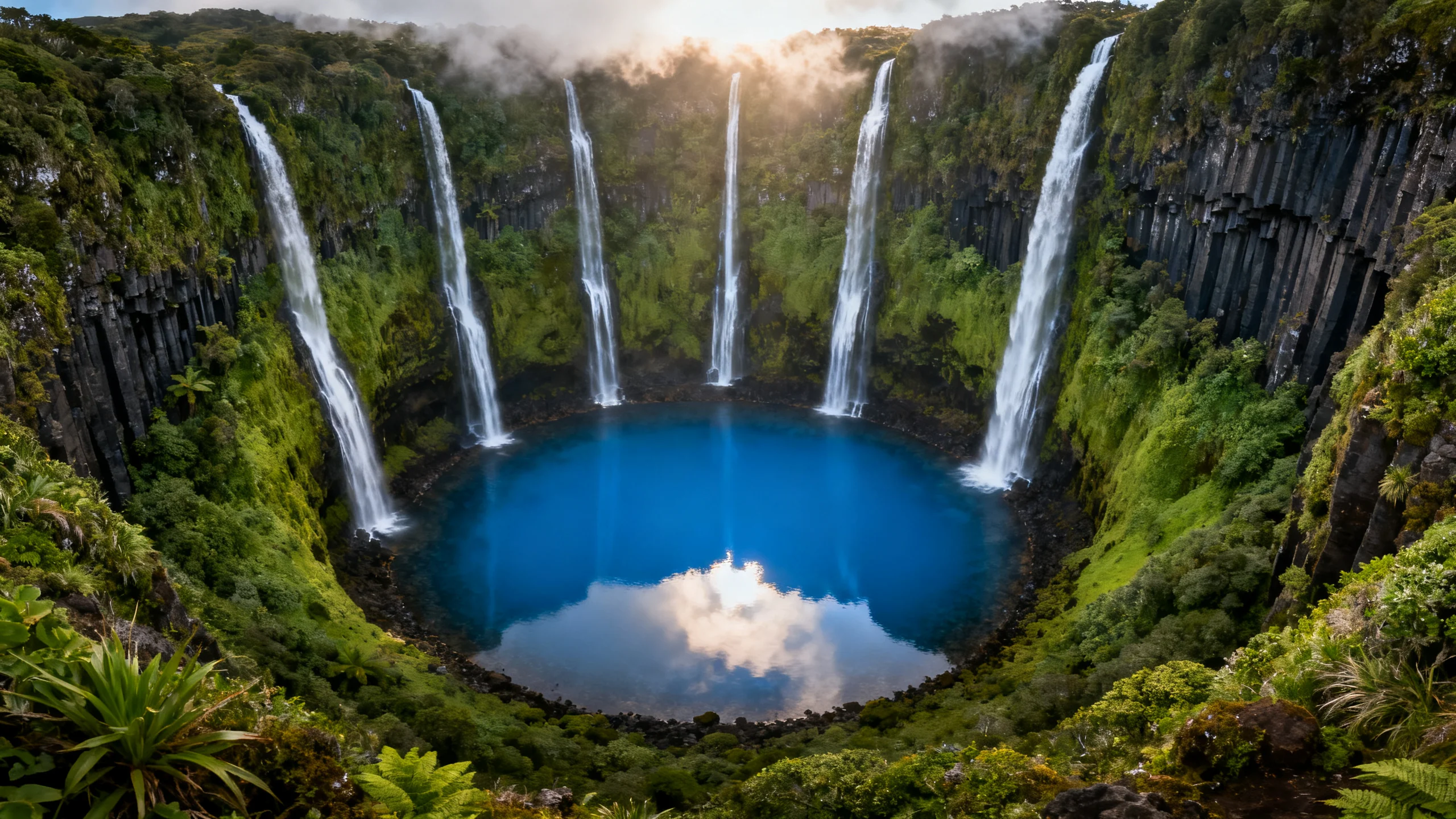
The signature site. Six named waterfalls cascade from the surrounding volcanic cliffs into a single circular basin with a small lagoon at the centre. The most photographed landscape on Flores and one of the most distinctive in the Azores.
Access: from the EN1 ring road, take the small turnoff signed "Ribeira do Ferreiro / Poço da Alagoinha". Park at the small lot, walk 20 minutes on a level trail to the viewpoint and lagoon. The trail is well-marked, family-friendly, no technical difficulty.
Best time: May to early July for full flow. By August only 3 to 4 of the 6 falls are running at meaningful volume.
2. Poço do Bacalhau
A single tall waterfall (around 90 metres) at Fajã Grande on the south-west coast. The fall plunges into a small pool at the base of the village. Reached via a 15-minute walk from the village centre or a 5-minute drive to the small parking area near the base.
Best for: close-up perspective, swimming in the pool below (cold but possible in summer), an easy half-hour outing.
3. The Ribeira Grande chain
A series of 4 to 5 connected smaller waterfalls along the Ribeira Grande river between the central plateau and the south coast. Visible from the EN3 road and from the Ribeira Grande viewpoint at the trailhead of the descent.
Access: from the EN3 between Lajes and Fazenda. Multiple viewing points; the lower trail descends from the viewpoint to the river, 30 minutes one way.
4. Cascata da Ribeira do Cabo
A 40-metre fall on the northern coast, near Cedros village. Less famous than Poço da Alagoinha and significantly less visited. Reached via a short trail from the Cedros road.
5. Cascata da Caveira
A small but photogenic fall on the south coast near Mosteiro village. The water cascades down a black basalt face directly into the ocean at high tide. Reached on foot from Mosteiro, 15 minutes.
6. Cascata do Pico do Furo
A two-stage waterfall on the eastern coast, near Lomba village. The upper drop is around 60 metres, the lower around 20. Less spectacular than the western coast falls but easier to reach by road.
7. Cascata do Rio Grande
On the EN1 between Santa Cruz and Fajã Grande, a small roadside cascade clearly visible from the road in spring. The kind of fall that would be a destination on a less cataract-rich island; on Flores it is a stop along the drive.
8. The temporary falls of the central plateau
After heavy rain (especially November to March), dozens of small temporary cascades appear on the central plateau and along the EN3 road. Most last 24 to 72 hours after a major rain event. The PR 1 FLO trail crosses several of these in spring.
A waterfall photography day
For travellers focused on waterfall photography, the right single-day pattern:
- 8:00: drive from Santa Cruz das Flores to Ribeira do Ferreiro (35 min).
- 8:45: walk to Poço da Alagoinha (20 min). Shoot the basin from 9am to 11am.
- 11:30: drive to Fajã Grande (15 min).
- 12:00: walk to Poço do Bacalhau. Lunch in Fajã Grande village.
- 14:30: drive the south-coast road via Mosteiro, stopping at Cascata da Caveira.
- 16:00: Lajes das Flores for the Ribeira Grande chain viewpoint.
- 18:00: Rocha dos Bordões at sunset (the basalt columns, not a waterfall but the right evening stop on the way back).
Gear and timing notes
- Tripod. Essential for long-exposure shots of the higher falls. The light in the basins is low even at midday.
- Polarising filter. Critical for cutting the wet-rock reflection at the base of the falls.
- Wide-angle lens. 16 to 24 mm captures the vertical scale of Poço da Alagoinha. Telephoto for compressed shots of the higher individual cascades.
- Waterproof bag. Spray near the falls is constant, especially in spring flow.
- Hiking shoes with grip. The trails are well-marked but wet rock can be slippery.