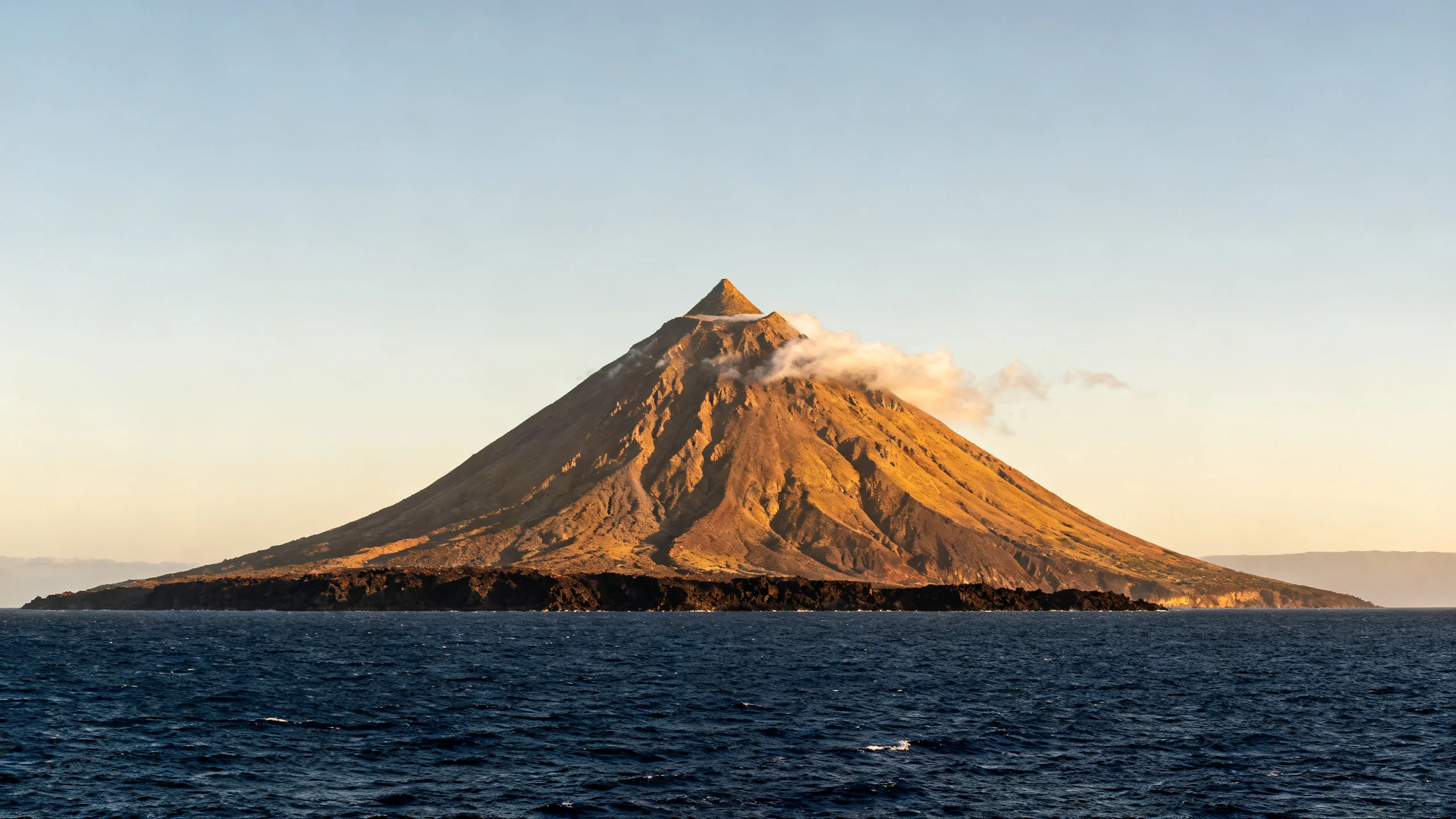
Pico is dominated by its single 2,351-metre stratovolcano, the highest peak in Portugal and the tallest mountain to rise directly from the ocean floor anywhere in the Atlantic. The island is harsh, black, and beautiful: lava fields run from the volcano to the coast, the vineyards are protected inside walled enclosures of basalt stone, and the historic whaling village of Lajes do Pico still sends boats out to watch what its grandfathers hunted.
Pico is the second-largest Azorean island by area but only the fifth by population. Most of the surface is the volcano itself, which dominates the silhouette from every other island in the central group. The west coast is the only side flat enough for a town, and that is where most visitors arrive: Madalena, on the ferry channel across from Horta on Faial.
This guide covers what to expect, when to come, the climb, the wine, and how to plan a stay of three to six days.
Why Pico
Pico is the most geological island in the archipelago. The black basalt lava fields, the perfect-cone volcano, the walled vineyards on the lava: nothing else in the Azores looks like this. The landscape is austere where São Miguel is green and Terceira is historical.
It is the right pick for travellers who hike, who care about wine, who photograph, and who want to combine a serious activity (the volcano climb) with the rest of the central group. It is the wrong pick for travellers who want concentrated tourist infrastructure or beach time. Pico’s beaches are black rock platforms, not sand.
Most Pico visitors combine the island with Faial, which sits 30 minutes away by ferry. The two are functionally a twin destination. Read this guide alongside the Faial pillar if you are planning that combination.
Geography and climate
Pico is a long narrow island, 46 kilometres east to west, 16 wide. The single 2,351-metre stratovolcano occupies the western half. An east-west ridge of smaller cones runs from the main volcano along the spine of the island to the eastern tip.
Madalena on the west coast is the main town and the ferry port to Horta on Faial. São Roque on the central north coast is the secondary town, with a small harbour and the main bus terminal. Lajes do Pico on the south coast is the historic whaling village, now a whale-watching base.
The climate is wetter than São Miguel (20% more rainfall on average) and slightly cooler. The summit of the volcano captures most of the cloud, so the slopes are often wet while the coast is sunny. The south coast (Lajes) is drier and warmer than the north (São Roque).
Top experiences on Pico
The Pico volcano climb. The signature experience of the island and one of the great Atlantic hikes. 1,200 metres of vertical gain from the base at Casa da Montanha (1,200 m) to the summit crater at 2,351 m. Mandatory guide, mandatory registration, tracker device required. Allow 7 to 9 hours round trip. See the Pico volcano climb guide for preparation, fitness requirements, and what to bring.
UNESCO Lajido vineyards. The wine-growing landscape of the northern coast is UNESCO World Heritage since 2004. Hundreds of hectares of small basalt-walled plots (currais), each enclosing a few vines, protect the plantings from the Atlantic wind. The Cooperativa Vinícola da Ilha do Pico at Madalena offers tastings, and the Lajido walking trail crosses the most scenic stretch of the protected area.
Whale and dolphin watching from Lajes. Lajes do Pico sits at the edge of a 1,000-metre underwater drop-off, the shortest run to deep water in the archipelago. Boats reach sperm whale habitat in 20 minutes instead of an hour. The whale watching trip from Lajes do Pico is the specialist’s pick, 4.8 rating, around €45 to €55, 3 hours. See the whale watching activity guide for the operator comparison.
The wine museum and Cooperativa. The Museu do Vinho in Madalena covers the 500-year history of Pico viticulture. The neighbouring Cooperativa Vinícola sells the full DOP range and offers tastings. Allow 90 minutes for both.
Lajes do Pico whaling history. The Museu dos Baleeiros in Lajes documents the Pico whaling industry that ran from the 1850s to the 1984 closure. Restored whaling boats, harpoons, scrimshaw, and the photographic archive. €4 entry. The neighbouring Casa dos Botes houses the original wooden whaleboats.
Lava walks and tube caves. The Furnas de Santo António lava-tube cave system on the central plateau is open via guided tour. The Lajido coastal walk crosses cooled basalt flows from the 1718 eruption. Both are short half-day options.
Cella Bar and modern Pico cuisine. The contemporary wood-sculpted Cella Bar on the Madalena seafront has become an architectural landmark (designed by FCC Arquitectura, opened 2014). Small plates of local cheese, octopus, and tuna sashimi paired with Pico wines. Around €20 to €30 per person.
Where to base yourself
Madalena is the obvious base for ferry access to Faial and for the volcano climb (40 minutes’ drive to Casa da Montanha). Most accommodation, easiest restaurant scene, the closest international flight connection (Pico Airport is 5 minutes north).
Lajes do Pico is the alternative on the south coast: the whaling village, smaller crowd, the right base if whale watching is your main reason for the trip.
São Roque in the central north has the best access to the UNESCO vineyards but the most limited accommodation choice.
The dedicated where to stay on Pico guide breaks the choice down by area, profile, and budget.
Getting to Pico
Direct flights to Pico Airport (PIX):
- Lisbon (LIS): TAP, 3 to 5 weekly, 2h30. Year-round.
- Terceira (TER): SATA, several weekly, 35 minutes.
- São Miguel (PDL): SATA, daily, 50 minutes.
- Faial (HOR): SATA, occasional, 10 minutes (or 30-minute ferry).
The realistic answer for most non-European visitors is via Lisbon or PDL. From the central group, ferry from Faial is faster than flying.
The Atlanticoline ferry between Madalena (PIX-side) and Horta (HOR) runs 8 to 10 times daily in summer, 4 to 6 in winter, €4.30 each way, 30 minutes crossing. Effectively a commuter service.
A dedicated guide on how to get to Pico covers airlines, the ferry, and the inter-island logic.
Getting around
A rental car is the right answer for Pico. The single ring road is 135 kilometres, the volcano access road is 12 kilometres of paved switchbacks, and the inter-village distances are too far to walk.
Companies: Ilha Verde, Autatlantis, and several smaller local operators. Compact car €25 to €60 per day depending on season. Reserve well in advance for July to August.
The local bus network (Empresa Auto Viação) runs limited routes between Madalena, São Roque, and Lajes do Pico, mostly on weekdays. Useful as a fallback but not a primary mobility plan for visitors.
Suggested itineraries
3 days, focused. Day 1: arrival, afternoon at the Museu do Vinho and a Cooperativa tasting in Madalena. Day 2: Pico volcano climb (full day). Day 3: drive to Lajes, Museu dos Baleeiros, afternoon whale watching from Lajes.
5 days, full island. Days 1 to 3 as above. Day 4: UNESCO Lajido walking trail and lava-tube tour. Day 5: ferry to Horta on Faial for a day trip (return same evening) or stay overnight and combine with the Faial pillar.
Best time to visit
- May to June: the best balance. Volcano accessible, weather stable, vineyards in spring growth, prices below peak.
- July to August: peak season, the busiest window for the volcano (book the guide 4 to 6 weeks ahead), wine harvest approaching.
- September to October: the grape harvest at the Lajido is in full swing, often the most distinctive cultural window. The volcano is still climbable, prices drop 20%.
- November to April: off-season. The volcano climb is rarely attempted, several restaurants in the north coast villages close, but the wine cooperatives are open and the south coast (Lajes) is still pleasant.
Frequently asked questions
How fit do I need to be to climb the volcano?
Reasonably fit. The hike is 1,200 metres of vertical in 4 to 5 hours up, sometimes on loose volcanic rock with the use of hands in the final 200 metres. It is not technical climbing but it is sustained, exposed, and weather-dependent. If you have done any European 2,000-metre peak before, you have done the rough equivalent. The volcano climb guide covers fitness, gear, and pace honestly.
Is the Pico wine actually good?
The DOP whites (Frei Gigante, Arinto dos Açores, Terras de Lava) are genuinely interesting wines: dry, mineral, high-acid, with a salt note from the maritime climate. Often compared to good Albariño or Muscadet. The reds are less convincing (the climate does not suit the red grapes). The fortified Lajido and Czar styles are historical curiosities worth tasting once but not the main event. See the Azorean cuisine guide for the broader context.
Can I do Pico in a day trip from Faial?
Yes, structurally easy. The Madalena-Horta ferry runs every 1 to 2 hours in summer, the crossing is 30 minutes. A 9am ferry from Horta and a 6pm return gives you a full day on Pico for the wine museum, a Lajido walk, and lunch in Madalena. The volcano climb needs an overnight (the dawn starts are not compatible with the ferry schedule).
How does Pico compare to São Miguel?
Pico is much more focused: one big mountain, one big landscape, one wine, one whaling town. São Miguel is a varied island with six or seven distinct attractions across one drive. Pico rewards travellers who want one or two big experiences (the climb, the wine), São Miguel rewards travellers who want range. Many travellers do both on the same trip (PDL to PIX direct flight) and find them complementary.
Why is Pico called the "grey island"?
The dark basalt lava that covers most of the visible landscape: the cooled lava fields, the walled vineyards, the village houses (built of the same local stone), the volcanic ash on the upper slopes of the volcano. Pico reads grey from a distance where the other islands read green. The nickname (Ilha Cinzenta in Portuguese) is descriptive rather than evocative; the island is genuinely the greyest in the archipelago.