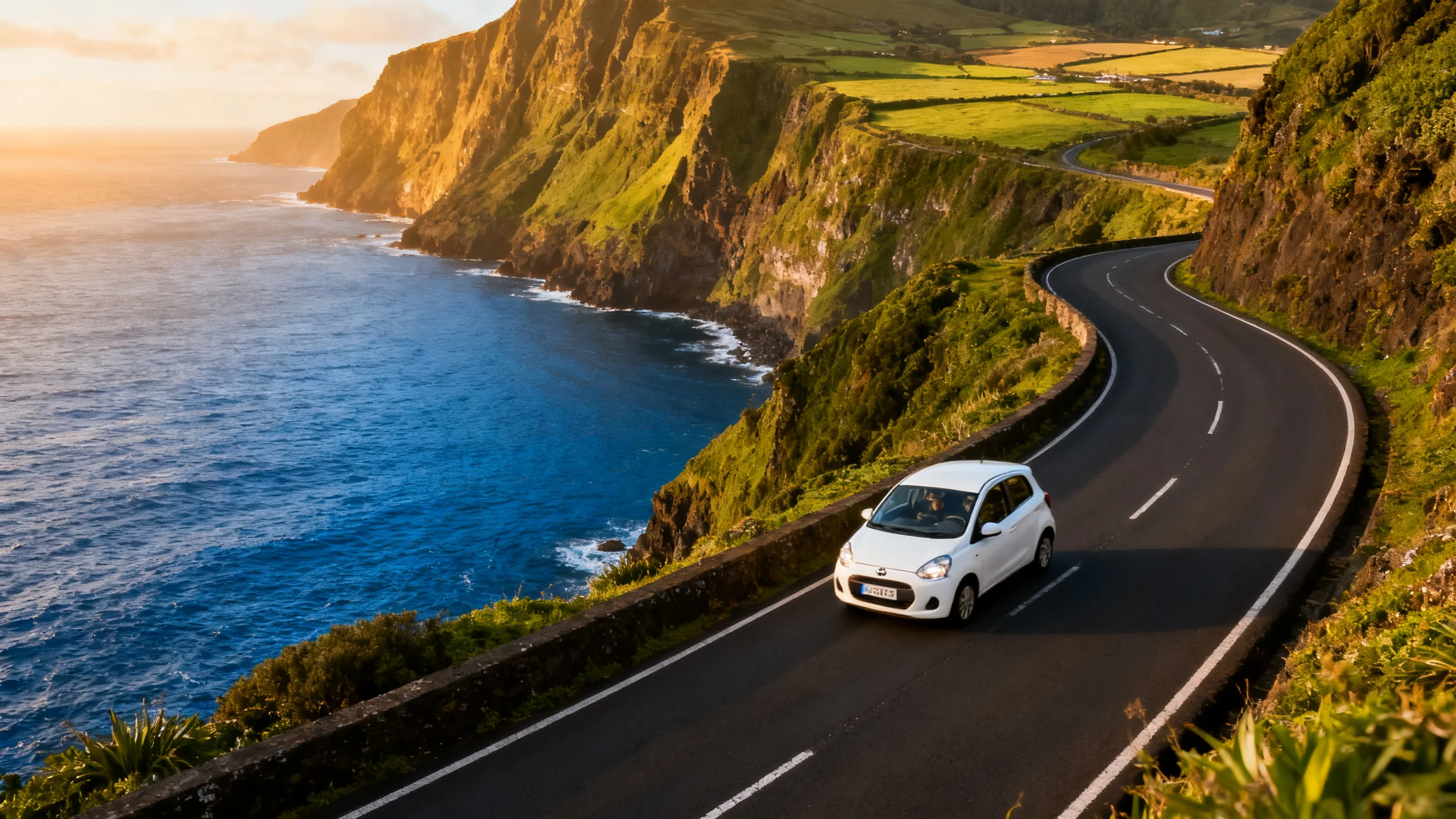
On-island mobility honest-talk. When to rent a car, when the bus actually works, the central-group ferry triangle, and how SATA flights connect everywhere else.
Mobility in the Azores is straightforward on the big island (São Miguel) and trickier on the smaller ones. The rental car is the default answer for most travellers, but it is not always the right one. Bus networks exist, the ferry triangle in the central group is real, and several islands are small enough to walk.
This guide breaks down the four options, when each makes sense, and the per-island recommendations.
The four modes
Rental car. The most flexible option. Available on every island with paved roads. Compact cars are abundant; bigger vehicles (jeeps, 9-seat vans) need to be booked weeks in advance for peak season.
Public bus. Year-round on São Miguel and Terceira, summer-only or sporadic on the others. Cheap (€2 to €4 per ride), built around local commuters and school runs, not tourists.
Inter-island ferry. Atlânticoline runs a year-round triangle between Faial, Pico and São Jorge in the central group. Summer extends to other islands. Frequent enough for day-trips inside the triangle.
SATA inter-island flight. A 30-minute turboprop hop between most island pairs, usually via Ponta Delgada or Terceira. Cheap if booked early, expensive at the gate. The only way to reach Flores, Corvo, or Santa Maria in a reasonable timeframe.
Rental car logic
For most travellers on São Miguel, the rental car is the right call. Public transport simply does not cover the rim viewpoints or the remote north-coast villages on a tourist’s schedule.
Costs (2026 average):
| Class | Daily rate (low season) | Daily rate (peak) |
|---|---|---|
| Compact (Fiat 500, Polo) | €25 to €35 | €50 to €75 |
| Mid-size (Corolla) | €35 to €50 | €65 to €95 |
| SUV / Jeep | €60 to €85 | €110 to €160 |
| 9-seat van | €80 to €110 | €150 to €220 |
Add €15 to €25 per day for full collision waiver if you do not have it through a credit card. Book through one of the local Azorean companies (Ilha Verde, Autatlantis, Wayzor) for cheaper rates than the international chains, especially booked direct rather than through aggregators.
The roads are well-paved on São Miguel, Terceira and Pico. On Santa Maria, Faial and São Jorge they are mostly paved with some dirt segments near rim trails. Flores and Corvo are paved but very narrow and steep. Driving is right-hand side, EU standard, your home licence is valid for short stays.
Petrol is around €1.85 to €2.05 per litre in 2026 (more expensive than mainland Portugal). Stations close at 8pm in towns, 6pm in villages, and Sundays except in PDL.
Public bus, by island
The bus is a real option on São Miguel and Terceira, marginal on the others.
São Miguel: Auto Viação Micaelense runs a network of 30+ lines. The useful ones for tourists: 401 (PDL to Ribeira Grande to Furnas, stops at the Lagoa do Fogo viewpoint), 209 (PDL to Mosteiros via Sete Cidades), 502 (PDL to Vila Franca do Campo). Frequency: 5 to 8 trips per day weekdays, 2 to 4 weekends. Tickets €1.80 to €4.10 depending on distance. Buy from the driver, cash preferred. Timetables on avianam.pt.
Terceira: Empresa Auto-Viação ETA runs the network. The Praia da Vitória to Angra do Heroísmo line (every 30 minutes weekdays) is genuinely frequent. The rest is school-run schedules.
Pico, Faial, São Jorge: Sporadic buses, generally too infrequent for visitor use.
Santa Maria, Graciosa, Flores, Corvo: Minibuses tied to school schedules. If you do not have a rental car, taxis or pre-booked transfers are the practical answer.
The central-group ferry triangle
The most surprising thing about Azorean travel is how usable the Faial-Pico-São Jorge ferry network is.
| Route | Crossing time | Frequency (summer) | Fare |
|---|---|---|---|
| Horta (Faial) to Madalena (Pico) | 30 min | 8 to 10 per day | €4.30 |
| Horta to Velas (São Jorge) | 90 min | 1 to 2 per day | €15 |
| Madalena to Velas | 90 min | 1 to 2 per day | €15 |
The Horta to Madalena crossing is essentially a commuter ferry. You can stay in Horta, take the 8:30am boat to Pico, climb the volcano, return on the 6pm. Or stay in Madalena and dine in Horta. The two islands function as a single destination.
In summer, ferries extend to Graciosa, Terceira and Santa Maria, but schedules are weather-dependent and not always daily. Verify on atlanticoline.pt before counting on them.
SATA inter-island flights
For anything outside the central-group triangle, SATA is the only practical answer.
Routes: São Miguel (PDL) and Terceira (TER) are the hubs; almost all inter-island flights route through one of them. Direct between the smaller islands is rare.
Aircraft: Bombardier Q200 (37 seats) for the smallest pairings, Q400 (78 seats) on the busier routes. Both turboprops. No business class, no priority lanes, very informal.
Pricing: Resident-rate fares (under €60 for any inter-island leg) are available to Azorean residents only. Tourist fares start around €90 one-way for short hops, €120 for longer, more if booked late.
Time: Flights are short (25 to 50 minutes) but the airport sequence (check in 60 min before, security, the small airports) adds 2 to 3 hours total to your day per leg.
Weather sensitivity: Inter-island services are noticeably more fragile than international ones. Cancellations or rerouting through a different airport happen 5 to 10% of the time in winter. Always keep a buffer day before your international departure.
Per-island recommendations
| Island | Car needed? | Best alternative |
|---|---|---|
| São Miguel | Strongly recommended | Bus 401 for Lagoa do Fogo + Furnas if no car |
| Terceira | Yes for the rim road | Praia-Angra bus + taxi for sights |
| Pico | Yes (the volcano trail starts 4 km from the village) | Bike rental in summer |
| Faial | Helpful but not essential | Walk or bike around Horta |
| São Jorge | Yes (the village-to-trailhead distances are 5+ km) | Pre-booked transfers |
| Santa Maria | Yes (tiny but spread out) | Pre-booked guided day-tour |
| Graciosa | Yes (similar) | Walking + occasional taxi |
| Flores | Yes (narrow steep roads, no real bus) | Guided tour with driver |
| Corvo | No (the whole island is 17 km², walkable) | Walk |
Frequently asked questions
Is Uber or any ride-hail app available?
Bolt operates a small fleet in Ponta Delgada (São Miguel) and limited service in Angra do Heroísmo (Terceira). Outside those two city centres, you call a taxi by phone or book through your hotel. Most taxis accept card payment but a few still cash-only; have €20 to €50 on you for backup.
Are roads dangerous?
Roads are well-maintained but narrow in the interior and the smaller islands. The main risks are sudden fog at altitude (Sete Cidades rim, Pico volcano, Lagoa do Fogo) and slippery roads after rain. Drive slower than the speed limit on unfamiliar mountain roads, especially after a rain band. Speed cameras are common in town and on the EN1 ring road, less so in the interior.
Can I rent an electric or hybrid car?
Yes on São Miguel and Terceira, where charging infrastructure exists (public chargers in Ponta Delgada, Ribeira Grande, Angra). Limited on the smaller islands. Book the EV early; the fleet is small. The geothermal grid means EV driving in the Azores is genuinely close to zero-emission, which suits the eco-tourism positioning if it matters to you.
How long does it take to drive around São Miguel?
The EN1 coastal ring road is 162 km. Driving non-stop, you can do it in 4 hours. With stops at viewpoints, lunch, and one swim, allow a full day. Two days lets you cover both halves at a more humane pace. The interior detours (Sete Cidades, Lagoa do Fogo, Furnas) each add 30 to 60 minutes one way.
What is the deal with the speed limits?
50 km/h in town, 90 on most rural roads, 100 to 120 on the few expressway segments around PDL. Police checks happen, the fines for foreigners are sometimes paid on the spot. The roads are scenic enough that you usually want to drive slower than the limit anyway.