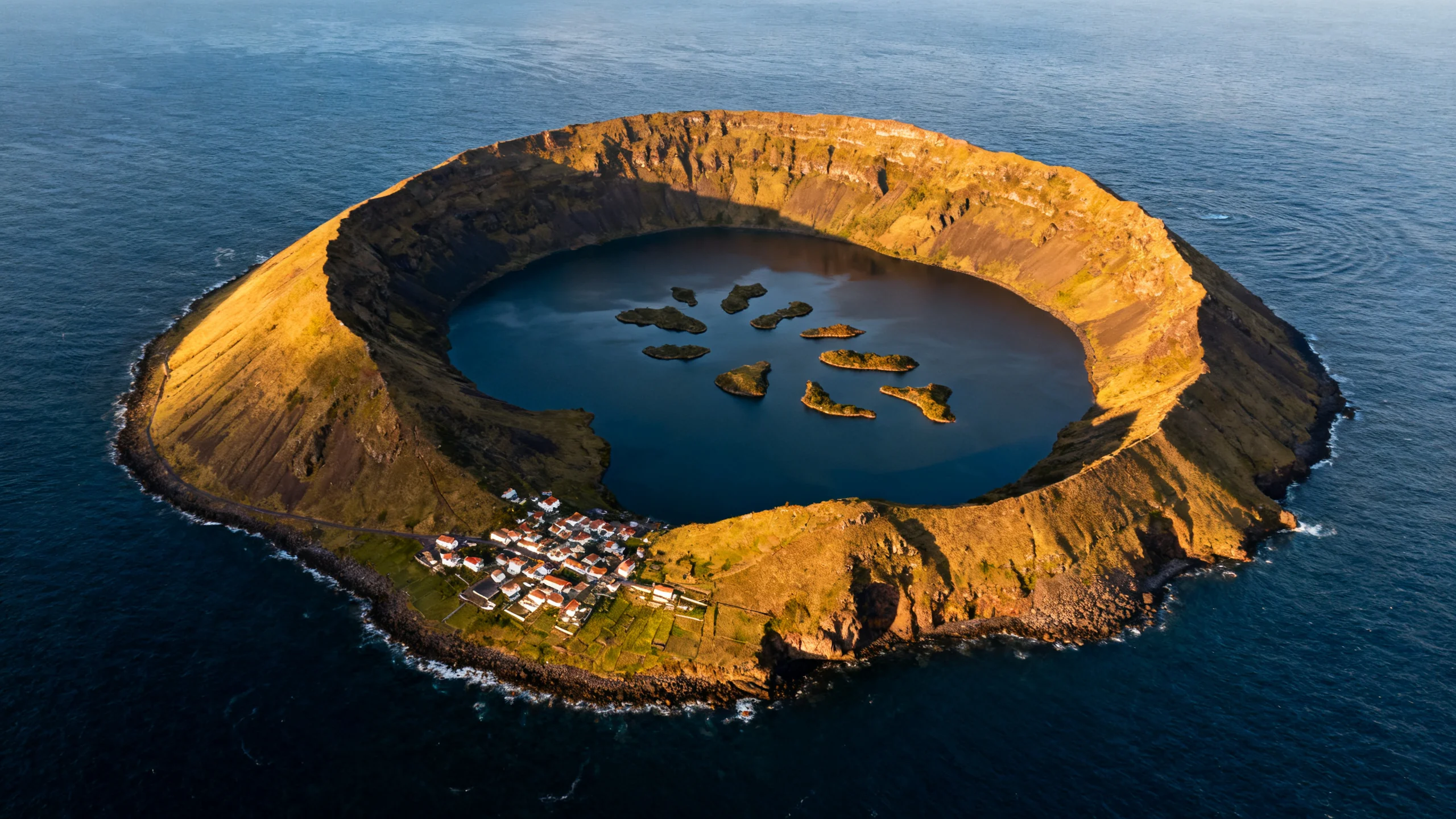
Corvo is the smallest of the Azorean islands, the smallest island in continental Europe, and the smallest permanent human settlement in the Azores. It is essentially a single volcano (the Caldeirão) with a single village (Vila do Corvo) at its base. The whole island is walkable end to end in a few hours. The permanent population of around 400 people lives in one village, on one street.
Corvo is the smallest of the nine Azorean islands, the most remote of them, and the only one that is essentially a single piece of geology: one volcano, one village, one road. The permanent population is around 400 people, all living in Vila do Corvo, the single settlement at the south foot of the Caldeirão.
This guide covers what to expect, why you visit, and how to plan a 1 to 2 day stay (almost always as a day trip or short extension from Flores).
Why Corvo
Corvo is for travellers who want the smallest, quietest, most distant version of the Azores. The whole island is a UNESCO biosphere reserve. The population has declined from 1,200 a century ago to around 400 today; the place is genuinely emptying out and this is part of its character.
The right way to think about Corvo is as a day trip (or one overnight) from Flores. The ferry crossing is 30 minutes from Lajes das Flores, sailings several times daily in summer. Most visitors arrive on the morning ferry, walk to the Caldeirão rim, have lunch in the village, and return on the evening ferry.
It is the wrong pick for travellers who want range, dining variety, or any tourist infrastructure beyond the bare minimum. There is one restaurant of consequence and one guesthouse.
Geography and climate
Corvo is 6 km north to south by 4 km east to west, with a single volcano (the Caldeirão) occupying most of the surface. The crater is around 2 kilometres wide at its rim, with a small permanent lake (Lagoa do Caldeirão) at the base and several small islets in the lake. Local legend says the islets resemble a miniature map of the Azores archipelago, which is true in a loose interpretation.
Vila do Corvo is the single village, on the south coast at the base of the volcano. The airport is 800 metres east of the village. A single road, the EN1, connects the village to the Caldeirão rim (4 km uphill) and continues no further.
The climate is similar to Flores: wettest part of the archipelago, mostly cloudy on the central peak, fast-moving rain bands. The village itself is comparatively sheltered. The Atlantic surrounds the island, so wind is constant.
Top experiences on Corvo
The Caldeirão rim walk. The 7-km loop trail around the rim of the central crater at 700 m altitude. Continuous views into the crater (with the lake and islets visible on clear days) and across to Flores on the western horizon. Trail-marked as PR 1 COR. Allow 3 hours including stops. See the Caldeirão of Corvo guide for the route detail.
Vila do Corvo walking tour. The village is a single curved street of stone houses, listed in 1970 as a national monument for its preserved 17th and 18th century architecture. Walk from the harbour up through the village to the small church, visit the tiny Eco Museu (€2 entry), have coffee at the only café. The whole circuit is 90 minutes at a slow pace.
Birdwatching in autumn. Corvo is famous in the European ornithology world for its transatlantic vagrants: American bird species blown across the Atlantic by autumn storms and stranded on Corvo for a few days before continuing. October is the peak month; species like the Solitary Sandpiper, American Golden Plover, and various warblers are regularly recorded.
The windmills. Several traditional stone windmills sit at the edge of the village, three or four still partially functional. The miller demonstrates the grinding mechanism on summer weekends.
Eco Museu do Corvo. The small island museum near the village square, with ethnographic collection, the history of the local whaling tradition, the bird collection from the autumn vagrant records. €2 entry. Allow 45 minutes.
Ferry day trip from Flores. Most Corvo visitors arrive on the morning ferry from Lajes das Flores and return in the evening. The schedule allows roughly 5 to 6 hours on the island, enough for the Caldeirão walk and the village circuit.
Where to base yourself
There is one realistic answer: Vila do Corvo. The village has 1 guesthouse, 2 to 3 small B&B rooms, and a handful of self-catering apartments. Everything is within a 5-minute walk.
The dedicated where to stay on Corvo guide covers the limited options.
Getting to Corvo
Corvo Airport (CVU) is the smallest commercial airport in the Azores. Direct service is genuinely sparse:
- Flores (FLW): SATA, 1 to 3 weekly, 15 minutes.
- Faial (HOR): SATA, 2 to 3 weekly, 45 minutes.
- Terceira (TER): SATA, 1 to 2 weekly, 70 minutes.
For most visitors, the flight is not the right answer. The Atlanticoline ferry from Lajes das Flores is the practical mechanism: 30-minute crossing, several daily sailings in summer, €15 one way. Ferry day trips from Flores are the standard pattern.
See how to get to Corvo for the detailed connection options.
Getting around
A rental car is not useful. The single road on the island is 4 kilometres long. Vila do Corvo is walkable end to end in 10 minutes. The Caldeirão walk is on foot. Most visitors do not rent a car at all.
A small handful of local minibus shuttles offer rides up to the Caldeirão rim trailhead (€5 each way) for visitors who do not want to walk the road up. Otherwise, walking and your feet.
Suggested itineraries
1-day ferry trip from Flores. Morning ferry from Lajes (around 9am), shuttle or walk up to the Caldeirão rim trailhead, walk the 7-km loop (3 hours), descend to Vila do Corvo, lunch in the village, walk through the village and visit the Eco Museu, evening ferry return (around 5pm).
Overnight stay. Same plan but stay one night, see the village in the morning before the day ferries arrive, return midday. The overnight is best for travellers who want the genuine quiet of the island after the day-trippers leave.
Best time to visit
- May to September: the best months for walking. Ferry sailings at full schedule, the Caldeirão visible most days.
- October: the rare-bird window. Crowded by birding standards (a few dozen birders) but still empty by tourist standards.
- November to April: off-season. Ferry sailings drop to 2 to 3 weekly and cancel often. The guesthouse may close. Visit only if you have the flexibility to absorb a weather-stranded day.
Frequently asked questions
Can I do Corvo as a day trip and still see everything?
Yes. The standard day trip covers the Caldeirão rim walk, the village circuit, and lunch with time to spare. The day-trip pattern is what most visitors do, and the island accommodates it comfortably. The overnight stay adds atmosphere (an empty village after the ferry leaves) but does not add new experiences.
Are the ferries reliable?
Summer (May to September): reasonably so, 90% of scheduled sailings run. Winter: less reliable, swell cancellations are common. Important practical note: if your morning sailing runs but the afternoon cancels, you may be stranded overnight without accommodation. Check the same-day forecast at the Lajes harbour before boarding the morning ferry.
Is the Caldeirão lake swimmable?
Technically yes, but no public access trail descends into the crater (the rim trail stays on top). Reaching the lake requires a steep off-trail descent that the rangers discourage and that puts the protected lake ecosystem at risk. The view from the rim is the right way to see it.
How much will I spend on Corvo?
Very little. Day trip from Flores: €30 ferry + €15 lunch + €2 to €5 museum or coffee = €50 total per person. Overnight stay: add €60 to €90 for the guesthouse plus an extra meal. Nothing is expensive on Corvo; the limit is what is available rather than the price.
Is the village really listed as a monument?
Yes. Vila do Corvo was classified as a national monument by the Portuguese government in 1970 because its architecture and street plan have been preserved largely unchanged since the 17th and 18th centuries. The narrow stone streets, the basalt house walls, the small chapel, the alignment of doors and windows all reflect the original settlement pattern. The classification means restoration work must preserve the historical character.